The Truth About Why Dogs Howl at Sirens

As I sat in my living room the other day, I was startled by the sudden sound of sirens blaring outside. But what really caught my attention was the immediate response from my dog - she began to howl at the top of her lungs. It was as if she was trying to join in with the sirens, creating a cacophony of sound that was both eerie and fascinating. This got me thinking - why do dogs howl at sirens in the first place? Is it just a natural instinct, or is there something more to it? In this article, we'll delve into the truth behind this phenomenon and explore the possible reasons why dogs howl at sirens.
Introduction to Canine Howling
Before we dive into the specifics of why dogs howl at sirens, it's essential to understand the basics of canine howling. Howling is a natural behavior for dogs, and they use it for various purposes, including communication, expression, and even location. Dogs are social animals, and howling is one way they can connect with their pack and convey messages over long distances. In the wild, wolves (the ancestors of domesticated dogs) use howling to locate each other, mark their territory, and even warn other wolves of potential threats. So, it's no surprise that domesticated dogs have inherited this trait and still exhibit howling behavior today.
 The Truth About Why Dogs Howl at Sirens Introduction to Canine Howling" loading="lazy" style="max-width:700px;width:100%;height:auto;border-radius:8px;">
Theories Behind Siren-Induced Howling
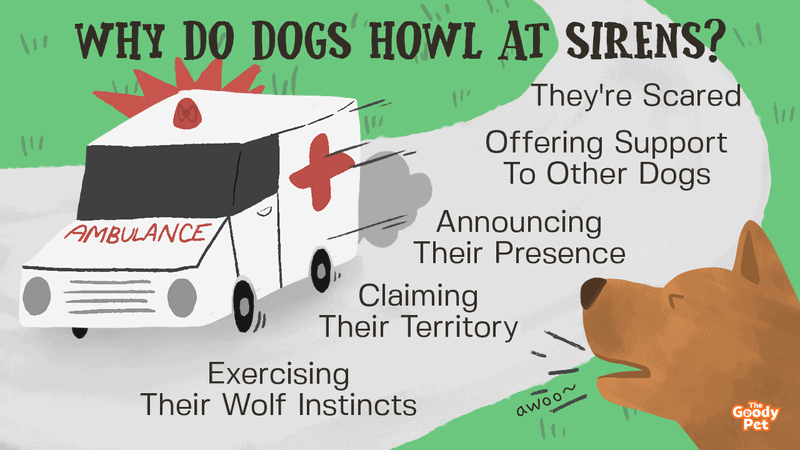
Now, let's get back to the question at hand - why do dogs howl at sirens? There are several theories that attempt to explain this behavior, and it's likely that the truth lies in a combination of these factors. One theory is that dogs howl at sirens because they perceive the sound as a howl itself. Sirens, particularly those used in emergency vehicles, produce a high-pitched, wailing sound that can be reminiscent of a wolf's howl. Dogs may be responding to this sound as if it were a member of their pack, howling back in an attempt to communicate or locate the source of the sound.
Another theory suggests that dogs howl at sirens due to anxiety or stress. The loud, piercing sound of a siren can be unsettling for dogs, and they may respond with howling as a way to release pent-up energy or calm themselves down. This theory is supported by the fact that some dogs will howl at other loud noises, such as thunderstorms or fireworks, which can also cause anxiety. Additionally, some dogs may have learned to associate the sound of sirens with the presence of their owners or other dogs, leading them to howl in anticipation or excitement.
The Role of Instinct and Evolution
It's also possible that dogs howl at sirens due to an instinctual response that's been passed down through their evolutionary history. In the wild, wolves would often howl in response to other wolves or even other animals, such as birds or monkeys. This howling served as a form of communication, allowing wolves to convey information about their location, social status, and even their emotional state. Domesticated dogs may still be driven by this instinct, responding to the sound of sirens as if it were a natural stimulus that requires a howling response.

Furthermore, some researchers believe that dogs may be responding to the pitch and frequency of sirens, which can be similar to the sounds made by their wild ancestors. Wolves are known to howl in the 80-150 Hz range, which is within the same frequency range as many sirens. This similarity in frequency may trigger an instinctual response in dogs, causing them to howl in response to the siren's sound. While this theory is still speculative, it highlights the complex and multifaceted nature of canine behavior and the many factors that can influence their responses to different stimuli.
The Science Behind Canine Hearing
To better understand why dogs howl at sirens, it's essential to consider the science behind canine hearing. Dogs have a unique auditory system that allows them to perceive sounds in a way that's different from humans. They can hear sounds at higher frequencies and have a more sensitive range of hearing, which enables them to detect subtle changes in their environment. This sensitivity to sound is thought to be an adaptation for their wild ancestors, who needed to detect prey or predators from a distance.
Research has shown that dogs can hear sounds up to 40,000 Hz, while humans can only hear sounds up to 20,000 Hz. This means that dogs may be picking up on high-frequency sounds that are imperceptible to humans, including the sound of sirens. Additionally, dogs have a more developed sense of hearing in the frequency range of 1,000-4,000 Hz, which is the same range as many siren sounds. This sensitivity to sound may contribute to their howling response, as they may be more easily startled or alerted by the sound of sirens.
Training and Socialization
While the theories mentioned above can help explain why dogs howl at sirens, it's also important to consider the role of training and socialization in shaping this behavior. Dogs that are well-socialized and trained may be less likely to howl at sirens, as they are more confident and calm in the presence of loud noises. On the other hand, dogs that are anxious or fearful may be more prone to howling in response to sirens, as they may be more easily startled or stressed by the sound.
Training can also play a significant role in reducing or eliminating siren-induced howling. By teaching dogs to associate the sound of sirens with a calm and relaxed state, owners can help their dogs learn to respond more appropriately to the sound. This can be achieved through desensitization and counterconditioning techniques, which involve gradually exposing the dog to the sound of sirens while providing positive reinforcement and rewards for calm behavior.

Conclusion
In conclusion, the truth behind why dogs howl at sirens is complex and multifaceted. While we can't pinpoint a single reason for this behavior, it's likely that a combination of instinct, anxiety, and conditioning all play a role. By understanding the science behind canine hearing and the evolutionary history of wolves, we can gain a deeper appreciation for the natural behaviors of our canine companions. Additionally, by providing proper training and socialization, we can help our dogs respond more calmly and confidently to the sound of sirens, reducing the likelihood of howling and creating a more harmonious environment for everyone involved.
0 Response to "The Truth About Why Dogs Howl at Sirens"
Post a Comment